9 Green

Wednesday, June 22, 2016
Green Speeds
I came across this article published by the USGA today. It does a phenomenal job explaining why and how green speeds can fluctuate from day to day. Take a minute and give it a look.

Tuesday, June 14, 2016
Trees, trees, trees!
The buzz around golf this week surrounds Oakmont, the US Open and their massive tree clearing effort. It's remarkable what they have done to the golf course and results that have been achieved. Below is some media that goes in depth as to why they did what they did. Every golf course removes trees, whether it's one or 100s. These pieces explain perfectly why we as superintendents do what we do. Enjoy!
Wednesday, January 13, 2016
Bonus Winter Work
 |
| Winter kill 5 green (2014) |
 |
| Installing drainage into 5 green |
 |
| Plywood wall on 1 bunker |
The past few weeks has been a return to typical Western New York winter weather. The ground has begun to freeze making for ideal conditions to remove some trees. For the rest of the winter we are focusing on removing many of the dead evergreen trees around the course, Many of these trees are diseased and reaching the end of their life cycle.
I also wanted to include a USGA article on why we closed off the greens for the winter. I always get questions on this and it does a great job explaining why we do.
http://www.usga.org/course-care/our-experts-explain0/managing-winter-play---why-can-t-we-tee-off-now-.html
Stay warm and we will see you in the spring!
Sunday, June 14, 2015
Rain rain go away!!
It's hard to wrap my head around the amount of rain we have recieved over the last week. Since last Satutday we have got 5.25", which does not include the .6" we got so far today. By the looks of it there is more on the way tonight and more chances of storms through out the week. A month ago we couldn't buy a drop, now we are praying for it to stop!
One silver lining in all this madness is watching all the drainage we put in over the past few years do its thing. In 2011 we drained 1 fairway. 2013 it was the small fairway on 12. In 2014 1 and 4 greens were regraded along with drainage in 15 rough. The project on 14 is in progress and is already paying dividends. Prior to the installation 14 fairway would be a lake and pumps would have to run for half a day just to clear the water. That's no more, we haven't needed a pump down there yet this year. If things ever decide to dry out we will be finishing the rough on 14, moving to the rough on 16 and the area near 13 tees. My guess is we have cut at least 3/4 of a day off our pumping and water removal. It's along process draining a golf course, but as you can see we have come along way!
Thank you for dealing with all the closures and restrictions. I implement these for the good of the course. To keep the course in good condition they are a necessity. As much as you don't like them I hate them even more. it's an inconvenience to you playing and us maintaining, With the forecast ahead calling for more rain these restrictions will remain in place until we dry out. I ask for your continued cooperation in following these restrictions and respect the golf course. Before long we will be dried out and praying for rain again!
Also please like the MGC Facebook page for real time updates on course conditions as well as the online weather station for up to the second weather conditions. These are two excellent resources and I encourage you to use them. Links to both are listed below.
Thanks!
http://www.facebook.com/MendonGolfClub
Thanks!
http://www.facebook.com/MendonGolfClub
Friday, May 22, 2015
Frost?!?!
Hard to believe we are talking about frost on Memorial Day weekend. This is a heads up for anyone looking to play Saturday morning May 23rd. The forecasted low temperature is 35 degrees. There is a high likely hood there will be a delay. Please plan accordingly and check in with the proshop before coming out to play. Hopefully the delay will be minimal and we can enjoy the holiday weekend.
Saturday, May 9, 2015
Busy, busy busy!!
 We have been hard at work repairing the areas from last seasons tree removals. It's a very important process that involves grinding the stump, picking up the grindings, digging out roots and filling the hole with soil. After the soil is leveled out a starter fertilizer is applied along with grass seed. With in a week we should see germination and with in a month it will be fully grown in. At the time of this post all the stump holes have been filled and seeded except for the area between 1 and 4 greens. This area is going to take some time to prepare and is on the to do list for next week.
13 tee is progressing nicely! We actually have some decent grass that has filled in the voids and the tee is looking healthy. We are planning on opening the tee starting Monday, May 18th for the U.S. Open Qualifer Tournament. As stated in prior posts, keeping the tee in this condition moving forward is going to require removing trees. This area is being pushed to the top of the list for this falls removals.
 I also wanted to address a question I have been asked by both you and my staff, "Why are there two large orange spots on 5 green"? If you remember last year we had large scale winter kill on these two spots. We reseeded these areas with bent grass. The orange color you see is a side effect from our poa annua seedhead suppression application. This application prevents the annoying seedhead that makes greens bumpy in the spring. The side effect of the application is the bent grass turning off color. The orange color is always more pronounced in younger bent grass plants. Luckily this is only temporary and it will dissipate in the next week or so.
You may also have noticed the rain shelters are currently being rebuilt. They are stronger and drier than ever!!
As you can see we are busy, busy, busy!!
Thursday, April 23, 2015
Aeration
Well the weather this week was far from ideal for aeration, but we powered through and completed the greens. Starting Monday we are planning on aerating tees and finishing solid tining the last few fairways. Aeration is a word golfers hate to hear, but this practice is vital in creating a healthy turf stand. I came across this video and wanted to share it with you. It does a great job explaining why we aerate. Have a look!
Wednesday, April 15, 2015
13 Tee
 As we all know growing grass on 13 Tee is not easy. The combination of shade, tree roots, and constant divots makes this our weakest tee. In an effort to get some grass growing on it for this season we have aerated, topdressed, over seeded and fertilized it. A cover has been put on the tee to encourage seed germination. Within a couple of weeks we should see some seedlings and hopefully have it playable come the middle of May. The long term solution to this problem is tree removal and we hope to begin the process this fall. In the mean time the tee will be closed to play. We will be scalping down some areas in the rough in an attempt to provide you as much teeing ground as possible. When the tee markers go out later this week please play the hole from where they are placed. They will be in some odd place compared to where you are used to.
Thanks for your cooperation.
Thursday, April 9, 2015
Course Update April 9th, 2015
It looks like the weather is finally turning the corner. The grass is starting to green up and we have started working on the course. The clean up process began this week by focusing on the playing surfaces. Fairways and tees have been cleared of debris and are ready for mowing. Now we need some dry weather to allow us to get on them with out doing damage. We have received .6" of rain so far this week with more on the way. My plan as of now is to open the course at the early part of next week. If the forecast holds true we will blow the greens off Monday and evaluate their firmness at that point. I am hoping to have flags in the greens by Tuesday afternoon at the latest. Stay tuned!
I am happy to report we have escaped the winter free of any winter kill. Unlike last year we will start 2015 on a strong note and will not have to deal with temporary greens. I am happy to see all of our struggles and hard work from 2014 have paid huge dividends. We how have greens with improved surface drainage and exposed to more sunlight from the tree removals. Tragedy can make you stronger and in our case this statement rings true!
I also wanted to inform you of my upcoming plan for spring aeration. The plan is to aerate greens starting Monday April 20th and finish on the 21st, as long as the weather cooperates. We will be pulling a small core, verticutting and topdressing. It will be the same process we did in the fall of 2014 and the greens should be fully healed in 10 to 14 days. This process is vital in producing the greens you have been acustom to.
As soon as greens are done we are planning on aerating tees in a similar fashion. We will be pulling a core and cleaning them up. We are also going to continue our fairway aeration program this spring. Last fall we pulled cores for the first time in along time and the fairways responded beautifully. This spring we will be solid tining the fairways to allow more space for roots to grow. Inturn this will create a strong plant that will be able to better withstand stresses, like we saw last summer. This process is low impact and will heal very quickly. The goal is to have all the faiways and tees done by May 1st.
As always I'm free to answer any questions you may have. Look forward to seeing you on Saturday at the Clean-up Day and in the coming weeks on the course.
Saturday, April 4, 2015
Live MGC Weather!
I wanted to make you aware of a powerful weather tool I have incorporated into the operation for the 2015 season. I recently linked our on-course weather station to an internet weather service called Weather Underground. Our weather station automatically uploads its data to the site and allows viewing from any internet connected device. You now can view the website and see real time, onsite conditions. Say its going to be cold one night this fall and there is a high likelihood of a frost delaying your morning round. You can now check the temperature in real-time at the course. Want to know how much rain we got? Check the weather station. As you can see this can be a valuable tool.
There are many way to access this information.
There are many way to access this information.
- There is a new weather widget on the right side of this main blog page. Just click on it to be re-directed to the website. This widget is only visible from a Mac or PC.
- Bookmark the following website on any of your devices and add the link to your desktop or mobile device's home page: http://www.wunderground.com/weather-forecast/zmw:14506.1.99999
- Download the Weather Underground App for iOS or Android:
I encourage you to utilize this information for the upcoming season. If you need help setting up your device, feel free to contact me and i will be more than happy to help!
Thursday, March 26, 2015
Snow Mold
I got a chance to tour the course this week. I am very encouraged by what I have seen so far. All the exposed turf looks healthy. There is still some deep snow out there in the shade, but hopefully we will make some gains on melting these areas this week. One thing there is a lot of this year is snow mold disease. This is a cold weather disease brought on by extended snow cover and melting snow. Conditions have been perfect for snow mold over the last few weeks. The deep, prolonged snow cover, in February activated the disease. As the snow started to melt it creates moisture on the surface and allows the disease to develop. Here is a link to a fact sheet on snow mold if you are interested, Snow Mold Fact Sheet.
We have a strong fungicide program in place to protect our greens, tees and fairways. In a typical year we will see 100% control on greens and a 90% control on tees and fairways. The uncovered greens, as of now, are completely disease free. Our tees and fairways are relatively clean, with the fungicides providing around 85% control. As you can see in the pictures, there is a stark difference between the untreated rough and the treated fairways. We are seeing spots of breakthrough here and there, especially in low lying and heavy snow covered areas. Seeing pictures like this is a reminder of how important our winter fungicide application is. Luckily this disease looks worse than it actually is. With some warm weather and some fertility, these areas will bounce right back.
As for opening the golf course we are still a ways off. The long term forecast is unfortunately calling for this cold pattern to persist. It will not take much to tip the scales in our favor, but we need cooperation from mother nature. I will keep you posted on a potential opening date.
 |
| 16 Fairway -- Treated vs Untreated |
 |
| 9 Fairway -- Treated vs Untreated |
We have a strong fungicide program in place to protect our greens, tees and fairways. In a typical year we will see 100% control on greens and a 90% control on tees and fairways. The uncovered greens, as of now, are completely disease free. Our tees and fairways are relatively clean, with the fungicides providing around 85% control. As you can see in the pictures, there is a stark difference between the untreated rough and the treated fairways. We are seeing spots of breakthrough here and there, especially in low lying and heavy snow covered areas. Seeing pictures like this is a reminder of how important our winter fungicide application is. Luckily this disease looks worse than it actually is. With some warm weather and some fertility, these areas will bounce right back.
As for opening the golf course we are still a ways off. The long term forecast is unfortunately calling for this cold pattern to persist. It will not take much to tip the scales in our favor, but we need cooperation from mother nature. I will keep you posted on a potential opening date.
Monday, March 16, 2015
The Big Melt
It's been a long winter, to say the least! Finally it seems there is some light at the end of the tunnel. Our sizable snow pack is slowly melting and some grass is starting to poke its head. I have had numerous people ask me over the past month how the course is doing with all this extreme weather. I thought I'd take minute to briefly update you.

@whec_kwilliams:
Not at all surprisingly, the CFS model has an overall chilly look to it in the Northeast next 45 days....
It may come as a surprise to you, but this winter has been ideal for the course. If you think back to November and December, the weather got consistently colder and we lacked a lot of significant snow. This allowed for frost to setup in the ground, allow the grass to properly harden off and prepare itself for winter. As January progressed into February it got historically cold and snowy. Fortunately we had a 2.5 foot blanket of snow protecting the grass from the elements. Exposed grass in those conditions would not have been a good thing. Unlike last winter we have not experienced the extreme freeze and thaw events. These events are what spell trouble for turf and what caused the damage we saw last year. So far March as been kind. The snowpack has slowly begun to recede. A nice slow melt helps to prevent our creek from flooding and allows for water to dissipate slowly. Hopefully we can lose the rest of this snow in the same manner before the spring rains arrive. The 10 day forecast looks promising in that regard, with no large storms on the horizon.
So where does this leave us moving forward? I have been looking at some long range forecasts and all signs are pointing towards a spring similar to 2014. Temperatures, on average, are forecasted to be below normal with near normal precipitation. Below is a 45 day temperature outlook and a post from a local meteorologist. The blues and greens represent cold air where the reds indicate warm. As you can see the green has parked itself in our neighborhood.

@whec_kwilliams:
Not at all surprisingly, the CFS model has an overall chilly look to it in the Northeast next 45 days....
Unfortunately this same forecast model has predicted, with a high degree of accuracy, the weather we have seen this winter. All we can do is hope a drastic pattern shift is in our future!
As for the course I am confident we will come out of this winter in great shape. Once the snow melts some more I will have a chance to get on the course an inspect things further. I had the chance to dig down and see the grass on the putting green last week. Everything looked great and that should be the case for the rest of the course. We still have around 8 inches of snow left to melt, so we are not completely out of the woods yet. Lucky we are so late in the winter season. If any ice or standing water forms, the likelihood of damage is small. I will keep you updated as the melt progresses.
Think spring and warm temperatures, we will be golfing before you know it!
Tuesday, September 16, 2014
It's that time of year again!
It's every golfers, I mean superintendent's, favorite time of year, AERATION! Yes the dreaded aeration is making a return in a few short weeks. We will be core aerating the greens on Monday September 29th and Tuesday September 30th, weather permitting. Processes will include verti-cutting, pulling a small core, topdressing and fertilizing. Impact will be similar to years past with complete healing in 10-14 days. As always aeration is a necessary evil to keep the greens in the condition you expect.
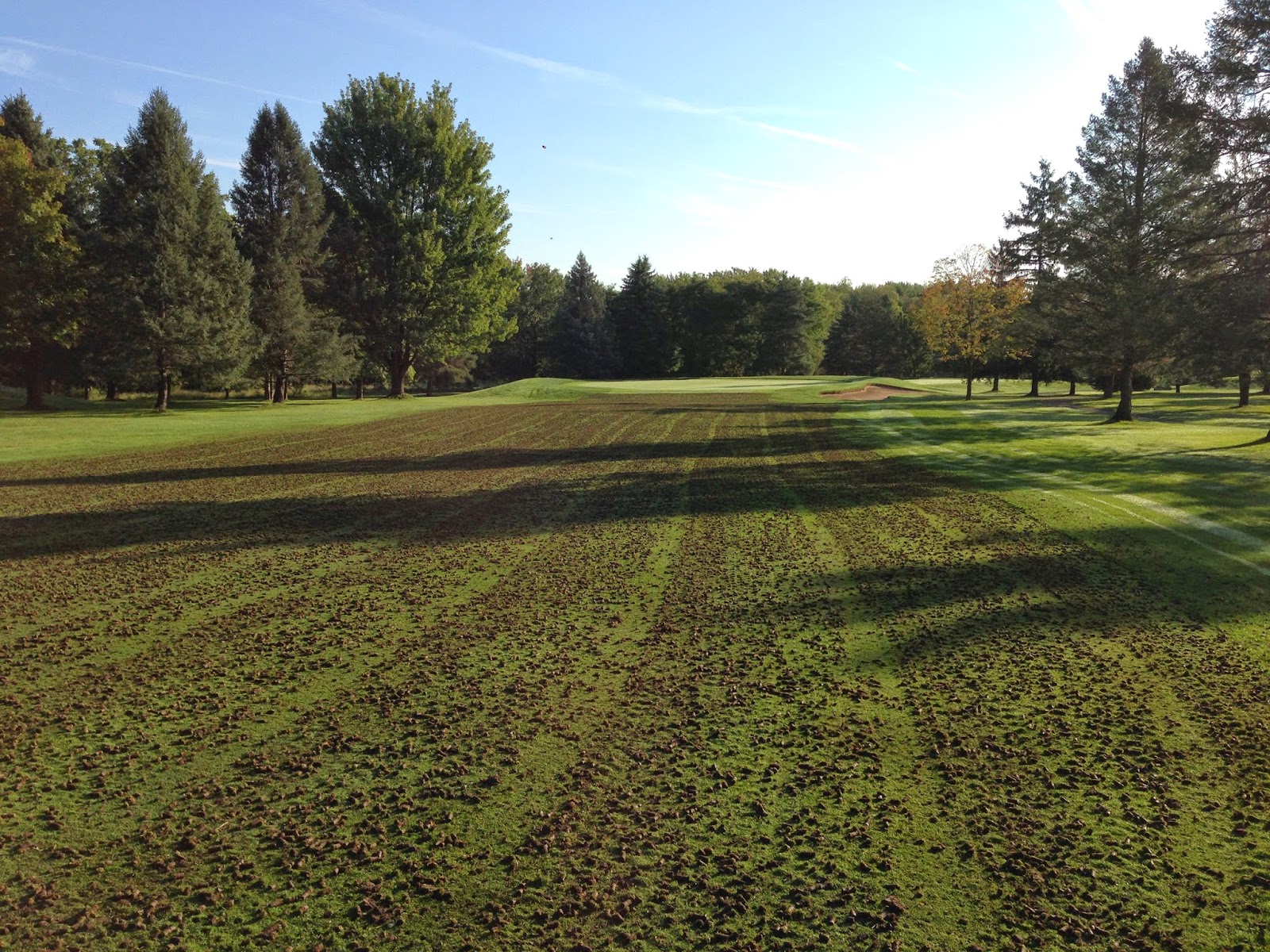 |
| Core aeration on 17 Fairway |
This fall we are also going to begin core aerating fairways. This process is very similar to the greens, but with out the sand. We will pull a core, drag the core to break up the soil, blow off the surface and mow to clean up any debris. This a very labor intensive process that is dependent upon dry, sunny weather. Our plan is to pick off two or three fairways a day as long as the weather allows. We are going to begin with the weaker fairways on the front nine starting tomorrow, Wednesday September 17th and go from there. This past Monday, 17 fairway was aerated to test out the equipment. Everything went very smooth and it turned out very good. That will give you an idea of what to expect. Like the greens, it will take around two weeks for them to heal. The short term disruption will pay huge dividends moving forward. I don't believe a core has ever been pulled on these fairways. A significant thatch layer has accumulated and areas have become compacted. which played a large role in why we saw the disease damage this season. By getting on this aeration program we will begin to reduce this layer, relieve the compaction and increase the overall health of the fairways. I would ask you to respect the staff as we begin this process. If we are working a hole you are playing, please give the staff the right of way. This is a new process for everyone, my staff included, so I ask for your cooperation and understanding. The quicker we can complete a hole the quicker we can have it back to you for play.
As always I am happy to answer any questions you might have,
Thanks again and enjoy the fall season!
Tuesday, July 29, 2014
Update 7/29/14
It has been a while since my last post. Things lately have been extremely busy and writing has taken a back seat. Monday, Mother Nature decided to impose her wrath on us once again to the tune of 3.6" of flooding rain. I haven't seen a steady, heavy rain like that in along time. Luckily it came early in the week and should provide ample time to dry down prior to the Invitational this weekend. Want to thank the crew for there hard work cleaning up from the storm. It seems like a broken record for us this year, but we push through and get the job done.
So that's all well and good, but why are we seeing what we have been seeing over the past month. Here is a snapshot of this months weather conditions.
I highlighted all the days we received significant rain events. This doesn't include our recent 3.6" event. Notice how most of our rainfall and high humidity for the month of July has fallen on league days and weekends. Those are obviously our peak play days and the days we strive for greens speed. These rain events wiped out any speed we might have had and set us back to square one. The event on the 15th was the wide spread wind damage we received so all resources went to clean-up. Same for the event on the 7th and 8th, all resources went to pumping water off the course. As for Men's League on the 23rd, two heavy down pours left us .75" of rain and standing water.
We also had the privilege of hosting the US Amateur qualifier earlier this month. Hosting an event like this requires us to produce extremely fast greens speeds. We double cut and rolled for 4 days prior to the event and also preformed these practices the night prior to and the morning of the event. This is what it takes to produce these speeds. In an ideal world we would like greens like this everyday, but at the end of the day it's not possible given our resources. It takes a lot of manpower, chemical, and ferilizer inputs to achieve this on a daily basis. Since this is not possible for us, we strive to find a happy medium and give you tournament speeds for special events. This is only a taste of a discussion on green speeds, but I hope it shed some light on this subject for you.
I want to address a few concerns that have been brought to my attention recently. Some of you have been asking about the speed and consistency of the greens. I will be the first to admit the greens have been all over the place though the month of July. To fully understand green speeds you must first understand the cultural practices it takes to get greens fast and consistent and how weather conditions effect the final outcome.
First off my goal each day is to provide you with the best possible putting surface with the resources I am provided. It takes a lot of mechanical and cultural inputs to produce a quality putting surface. On a daily basis we mow the greens. On league days and weekends the greens are either double cut or single cut and rolled. On average that produces the desired speed and consistency we are looking to achieve. This all gets thrown off when the weather decides to throw a wrench into our plans. Rainfall and humidity are the biggest environmental factors that effect speed. More moisture means a slower green. Heavy rain events also prevent us from preforming necessary mowing and rolling. Mowing a saturated green is the worst thing you can do for plant health and many times mowing will be skipped following heavy rains. These rain events and humidity also increase the growth of the plant. The more the plant grows the slower the speeds. We utilize weekly applications of growth regulators to even out the peaks and valleys in growth. More times than not a heavy rain event can negate the effect of the regulator and a flush of growth occurs. More growth equals slower greens. This season has been exceptionally different in terms of maintenance practices due to the winter kill we experienced. I have had at least three different cultural programs in place simultaneously on a single green. The damaged greens receive different inputs than the rest of the course to promote recovery. When you promote recovery you promote growth. As I stated above growth slows down greens. 1 and 4 greens right now are like managing two different greens on the same green. Half the green aerated with high fertility and half the green on a normal program. So this makes for different speeds on the same green and different speeds as compared to the rest of the course. This is where the consistancey issues comes into play. It has been exceptionally difficult to achieve our desired goals this season.
First off my goal each day is to provide you with the best possible putting surface with the resources I am provided. It takes a lot of mechanical and cultural inputs to produce a quality putting surface. On a daily basis we mow the greens. On league days and weekends the greens are either double cut or single cut and rolled. On average that produces the desired speed and consistency we are looking to achieve. This all gets thrown off when the weather decides to throw a wrench into our plans. Rainfall and humidity are the biggest environmental factors that effect speed. More moisture means a slower green. Heavy rain events also prevent us from preforming necessary mowing and rolling. Mowing a saturated green is the worst thing you can do for plant health and many times mowing will be skipped following heavy rains. These rain events and humidity also increase the growth of the plant. The more the plant grows the slower the speeds. We utilize weekly applications of growth regulators to even out the peaks and valleys in growth. More times than not a heavy rain event can negate the effect of the regulator and a flush of growth occurs. More growth equals slower greens. This season has been exceptionally different in terms of maintenance practices due to the winter kill we experienced. I have had at least three different cultural programs in place simultaneously on a single green. The damaged greens receive different inputs than the rest of the course to promote recovery. When you promote recovery you promote growth. As I stated above growth slows down greens. 1 and 4 greens right now are like managing two different greens on the same green. Half the green aerated with high fertility and half the green on a normal program. So this makes for different speeds on the same green and different speeds as compared to the rest of the course. This is where the consistancey issues comes into play. It has been exceptionally difficult to achieve our desired goals this season.
So that's all well and good, but why are we seeing what we have been seeing over the past month. Here is a snapshot of this months weather conditions.
| 2014 | Temp. (°F) | Dew Point (°F) | Wind (mph) | Precip. (in) | Events | |||
| Jul | high | low | high | low | high | high | sum | |
| 1 | 89 | 74 | 71 | 62 | 30 | 38 | 0.01 | |
| 2 | 88 | 69 | 69 | 59 | 21 | 28 | 0.02 | Rain/T-Storms |
| 3 | 75 | 62 | 67 | 61 | 17 | 23 | 0.43 | Rain |
| 4 | 73 | 58 | 58 | 46 | 20 | 25 | T | |
| 5 | 80 | 52 | 53 | 44 | 20 | 28 | 0 | |
| 6 | 83 | 55 | 62 | 42 | 20 | 24 | 0 | |
| 7 | 80 | 65 | 70 | 52 | 26 | 36 | 0.47 | Rain/T-Storms |
| 8 | 82 | 67 | 72 | 60 | 30 | 43 | 1.03 | Rain/T-Storms |
| 9 | 73 | 60 | 62 | 54 | 21 | 29 | T | |
| 10 | 74 | 53 | 54 | 43 | 15 | 22 | 0 | |
| 11 | 79 | 53 | 56 | 48 | 14 | 18 | 0 | |
| 12 | 85 | 60 | 63 | 55 | 12 | 15 | 0 | |
| 13 | 79 | 68 | 72 | 61 | 21 | 28 | 0.41 | Rain |
| 14 | 78 | 65 | 68 | 51 | 14 | 16 | T | Rain |
| 15 | 79 | 60 | 68 | 50 | 23 | 31 | 0.87 | Rain/T-Storms |
| 16 | 74 | 58 | 54 | 51 | 18 | 26 | 0 | |
| 17 | 75 | 54 | 55 | 48 | 14 | 17 | 0 | |
| 18 | 77 | 53 | 56 | 45 | 12 | 15 | 0 | |
| 19 | 76 | 58 | 65 | 51 | 12 | 15 | 0.15 | Rain |
| 20 | 79 | 64 | 66 | 61 | 14 | 17 | 0.28 | Rain |
| 21 | 84 | 65 | 67 | 63 | 15 | 17 | 0 | |
| 22 | 88 | 63 | 68 | 62 | 12 | 15 | 0 | Fog |
| 23 | 82 | 69 | 70 | 66 | 18 | 25 | 0.75 | Rain |
I highlighted all the days we received significant rain events. This doesn't include our recent 3.6" event. Notice how most of our rainfall and high humidity for the month of July has fallen on league days and weekends. Those are obviously our peak play days and the days we strive for greens speed. These rain events wiped out any speed we might have had and set us back to square one. The event on the 15th was the wide spread wind damage we received so all resources went to clean-up. Same for the event on the 7th and 8th, all resources went to pumping water off the course. As for Men's League on the 23rd, two heavy down pours left us .75" of rain and standing water.
We also had the privilege of hosting the US Amateur qualifier earlier this month. Hosting an event like this requires us to produce extremely fast greens speeds. We double cut and rolled for 4 days prior to the event and also preformed these practices the night prior to and the morning of the event. This is what it takes to produce these speeds. In an ideal world we would like greens like this everyday, but at the end of the day it's not possible given our resources. It takes a lot of manpower, chemical, and ferilizer inputs to achieve this on a daily basis. Since this is not possible for us, we strive to find a happy medium and give you tournament speeds for special events. This is only a taste of a discussion on green speeds, but I hope it shed some light on this subject for you.
The second thing brought to my attention is the browish areas of turf on the front nine fairways. These areas are caused by a disease known as Anthracnose. This disease attacks all types of turf, but especially preys upon annual bluegrass. The disease occurs naturally in the soil and begins to damage turf when conditions are right. Anthracnose is most severe on stressed turf under high humidity and moisture. If you go back to the weather records above we had near 90 degree weather at the beginning of the month with a rain event. This began stressing the annual bluegrass on our fairways. That was followed by some drier weather and some drought stress while trying to produce some firm surfaces for the Amateur Quailifer. The drought stress further hurt the turf and the infection took hold. We experience damage from this disease every year, but never to this extent. By nature annual bluegrass is a weaker species of turf, which is more susceptible to stress. The extreme winter we experienced really took a toll on the bluegrass. An already weak plant started the season off weaker than normal setting us up for what we are experiencing now. This disease can be controlled with fungicides. Our spray program on fairways is geared towards preventing most summer diseases. Anthracnose control how ever takes higher doses of fungicides which are beyond our resources. We try and combat this problem with increased fertility to build a healthier plant that will with stand attacks. Even with best laided plans Mother Nature exposed a weakness. It will take time, but the turf is recovering. Additional fungicides have been applied along with a healthy dose of fertilizer. Not only is this disease attacking our fairways, but it has gotten some of our collars and approach areas in front of the greens. It is not pretty to look at, but it will recover.
Like I said earlier this year, this season would be challenging due to the winter we experienced. Here we are in late July and still seeing the effects. If you have any further questions I would be more than happy to address them.
Sunday, June 8, 2014
Course Update 6-7-14
The hot button question everyone has been asking is when 1 and 4 greens are going to open. For those of you have been out there lately you have noticed my staff working hard plugging out the rest of the winterkill areas on 4 green this past week. They worked four straight, 9 hour days trying to get the work completed and I have to say they knocked it out of the park! Like the sod, plugging is a slow tedious process to get it right. I think it has turned out perfect and with time the plugs, like the sod, will blend in and disappear. They also started pluging on 1 green and should finish by the end of the day Tuesday. My plan is to open the greens for play this coming Wednesday. That being said there is still a lot of healing and recovery to go. The sod has rooted extremely well. It is still in some what of a fragile state, so the hole locations will be kept away from them for the near future. This surely will make for some interesting hole locations! I have been putting over the sod the last couple of days and it's extremely playable. It will be bumpier than a "normal" green, but nothing you can't handle. Moving forward we will continue topdressings to increase smoothness and hope to aerify them in a couple weeks. Again, I appericate everyone's kind words and support over the last few months. They go along way towards boosting morale. It has been a challenge this spring to say the least. We have been hit with a flood, a straight line wind storm, winterkill and not to mention all of our normal maintenance work to complete. A big hats off to my staff for working some long days. They have done everything asked and then some!
We will continue plugging out some select areas on 6,7 and 17 greens to help speed recovery. These greens have come along way on their own and these plugs will help finish the recovery. The two spots on 5 green are coming along slow and steadily. We have seen great germination from two rounds of seeding. We will continue aerating, topdressing and seeding until the areas fill in completely.
This past week was very productive on other areas of the course. The drainage at the putting green was completed. We also got all the stumpholes leveled, seeded and covered. This coming week we are planning to clean up the drainage on 1 and repairing drainage near 18 green and 2 tee. Beyond that the main project focus will be draining the rough between 14 and 15 faiways. By adding drainage and removing some select trees we can dry the area up and actually establish some grass. I will keep you updated in future posts on our progress.
It looks like summer weather is finally taking hold. I hope to see you out there in the near future!
Tuesday, May 27, 2014
Moving Forward
As you may have seen 1 and 4 greens have been sodded. It was a long, tedious process that went very smooth. I have to hand it to my staff, they stepped up and did a phenominal job! Here is a step by step photo tour of what we did.


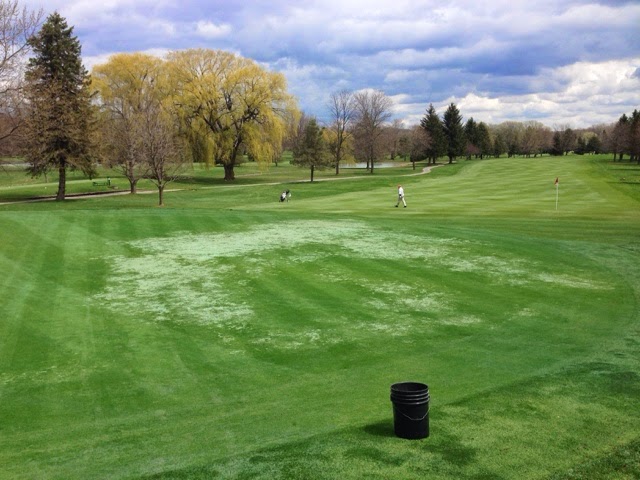

1. We identified the areas to be sodded and removed the dead turf.
2. After the sod was removed we utilized a laser level to map out the surface grade of the effected areas. These areas are notorious for holding water and was the main contributing factor to why the grass died. We regraded the areas to promote surface drainage. This was the most important step of the entire process to ensure the long term success of the greens. A big thanks to Frank Puccia at Irondequoit Country Club for letting us borrow his laser level!
3. Once the surface grade was established we started the meticulous process of laying the sod.
4. As the sections of sod were layed we hand tamped each peice and filled all the seams with topdressing sand. The sand will speed the healing process and help each piece to become one.
5. After the sod was installed we watered the sod heavily to wash in any surface debris. Soon after the sod was rolled in serveral directions to begin smoothing the surface.
6. Once the surface dryed we applied an extremely heavy layer of topdressing sand. The sand will be the key to smoothing the surface moving forward. Many more applications similar to this will be applied.
7. Here is a before and after of 1 green.
As the sod begins to root, we will be installing smaller round 2" plugs and larger hexagon plugs to some areas on these two greens. There are still several areas that are thin, but did not warrant sod. By installing these plugs, along with some seed and sand, it will help speed recovery. We will also be utilizing plugs on some of the other greens that were damaged such as 6,7 and 17. My hope is to have all the plugs installed in the next 7-10 days. Once we are finished with all the repair work we will reestablish the south practice green. My hope is to begin mowing the new sod at weeks end. We will follow that with more rolling, topdressing and aerations. It is going to take time for these areas to behave like the greens you are use to. Once the sod roots we can start talking about opening the greens for play. My hope is 2-3 weeks from today. I will keep you posted.
I want to thank you for your continued support and understanding. This has been a tough spring to say least. Nothing has gone as planned for anyone in the industry so far, including us. The mantra has been adapt and move forward. I feel we are doing that and taking things one day at a time. I want to leave you with some light reading. Here are a few links to some industry articles from the past few weeks.
USGA Regional Update:
Detroit Metro News:
http://www.detroitnews.com/article/20140524/METRO08/305240018/Rough-time-Detroit-area-s-golf-courses
Turfnet Recovery Article:
Michigan State University
Subscribe to:
Posts (Atom)